Can a Socratic Dialogue Be Programmed? What Plato Teaches AI Tutors
Define, refute, bring ideas to birth: a functional analysis of Socrates' questions, and what an AI tutor can take from them without forgetting Vygotsky's scaffolding.
This article is also available in French.
Many of us studied a Platonic dialogue at school. We remember a text in which Socrates asks his interlocutor questions and, question after question, a certainty collapses. Now that large language models can hold a conversation, the idea is everywhere: what if software could question like Socrates? This article takes the question seriously, which means analyzing what Socrates' questions actually do before deciding what a program can reproduce.
Four ways of "questioning like Socrates"
The phrase covers at least four different practices that are often confused.
- A teaching device: a teacher who plays the ignorant and leads the student, through questions, to formulate an answer or an understanding by themselves.
- Maieutics: a dialectical introspection that gives birth to knowledge the interlocutor was carrying without knowing it. Socrates compares himself to his mother, a midwife.
- The elenchus: an examination that clarifies an opinion and refutes it, sometimes leading to aporia, that perplexity in the face of one's own ignorance.
- An ethical exercise: the examination of one's life, actions, judgments and values. "The unexamined life is not worth living."
This last point is often forgotten. The themes of the Socratic dialogues are almost all moral: courage, piety, justice, wisdom, the good life. That context forces Socrates' interlocutors to say what they really think, since they are talking about the content of their own lives. Does the method remain valid when applied to photosynthesis or quadratic equations? Nothing guarantees it a priori. That is the first question to ask before programming anything.
A functional analysis of the questions
When preparing to implement a system, you carry out what is called a functional analysis: you break down what the system does into functions, then implement them one by one. Here, the functions we care about are not those of the dialogue as a text, nor the effects of reading it on us. They are the functions of Socrates' questions on the person who has to answer them.
Several can be distinguished.
Defining. These are the first questions that come to mind when we think of philosophy. "What do you call thinking?" asks Socrates in the Theaetetus. "What do you say the pious is?" in the Euthyphro. "What is temperance, in your opinion?" in the Charmides. The function is to force the interlocutor to spell out a concept they believed they mastered.
Examining and refuting. This is the elenchus, and it makes up by far the largest part of the dialogues. The mechanism is always the same. The interlocutor asserts a thesis. Socrates obtains, through a few questions, their agreement on additional premises that seem obvious. Then he shows, through further questions, that these premises logically imply the negation of the initial thesis. The interlocutor contradicts himself: nobody refuted him from the outside.
Clarifying and exemplifying. Asking for an example, a counter-example, a distinction between two close cases.
Remembering. Recollection: leading the person to mobilize what they already know, often without having connected it to the present question.
Comparing. Analogy, which brings two concepts together to reveal a difference, and irony, which underlines the gap between opinion and true understanding.
Many dialogues follow a three-step progression: identifying the question, criticizing the question as it was asked, then problematizing it, that is, confirming that there is indeed a problem and that progress is possible.
What recent research has done with it
Several studies have tried to translate these functions into instructions for a language model. A 2023 paper, "Prompting Large Language Models with the Socratic Method", lists rules close to what a good seminar leader applies spontaneously:
- ask open questions to stimulate thinking;
- help clarify and define the relevant terms;
- encourage the person to give examples or evidence;
- lead them to doubt their conclusions;
- help them summarize and draw conclusions;
- help them reflect on the method itself and on what was learned during the dialogue.
The same paper distinguishes the techniques involved: definition, generalization (drawing principles from recurring patterns), induction, elenchus (testing the consistency of a hypothesis), hypothesis elimination, maieutics, dialectic (exploring opposing views), recollection, irony and analogy. A more recent work, "Dialogic Pedagogy for Large Language Models" (2025), goes further by confronting the conversational strategies of models with established theories of learning, rather than with the figure of Socrates alone.
The practical result is mixed. A language model is very good at producing an open question, asking for an example or restating. It is much less good at conducting an elenchus, because an elenchus requires holding on to the initial thesis, choosing the right intermediate premises and keeping the logical chain intact over several turns. Above all, it does not know, on its own, when to stop.
Socratic and constructivist
In everyday pedagogical vocabulary, "Socratic" has almost become a synonym for "constructivist". Any strategy that fosters autonomous reflection and discovery learning gets called a Socratic dialogue. That keeps a single function of Socrates, maieutics: dialogue as a method for generating knowledge through introspection.
This reading is legitimate but it has a cost. Plato's Socrates leads his interlocutors to aporia far more often than to knowledge. For a philosopher, aporia is a beginning. For a learner trying to understand fractions, it is mostly frustration.
What Socrates lacks: the zone of proximal development
This is where the psychology of learning becomes indispensable. Lev Vygotsky stressed the social aspects of human learning: we learn, to a large extent, thanks to other, more competent humans. Three of his concepts directly concern a tutor who asks questions.
The zone of proximal development designates what we do not yet understand but can almost understand: what we can do with help, and what that assisted experience will later allow us to do alone. Outside this zone there is nothing to learn: either the task is already mastered, or it is out of reach.
Scaffolding is the help needed to operate within that zone. Wood, Bruner and Ross described six functions: recruiting the learner (getting them on board and motivated), reducing the degrees of freedom of the task, maintaining direction, marking critical features, controlling frustration and demonstrating.
Stagnation is what happens when you work on what you already know.
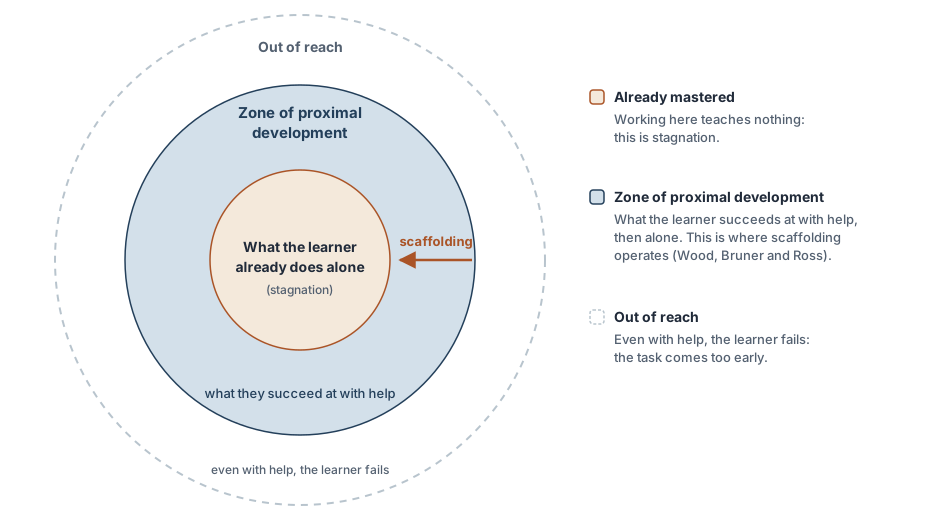
A Socratic tutor without a learner model does not know which zone it is in. It may ask a definition question of someone who needs an example, or launch a refutation at someone who is about to give up. Motivational help (making sure the learner cares about the exercise, keeping attention on the task rather than on a technique already mastered, softening frustration and switching activity before it becomes a problem) matters as much as pedagogical help.
The building blocks of an intelligent tutor
Intelligent tutoring systems, studied since the 1980s, rest on four components: the teaching material, the teaching strategy, the learner model and the interface. Socratic dialogue is a strategy. It is only worth something if the other three blocks exist, and in particular the learner model: their interest in the topic and in the exercise, their attitude towards difficulty, their tolerance for frustration, what they have already succeeded at and failed.
That is the choice we made in Fenelon. Open questions are assessed against explicit answer criteria, which makes it possible to pinpoint what was not understood. Feedback does not hand over the answer: it asks first, in the manner of Socrates, but it also knows when to step down a level, change activity or simply explain. Questioning is one tool among others, chosen according to the learner's state, not a posture.
Conclusion
Can a Socratic dialogue be programmed? Its functions can: defining, exemplifying, refuting, prompting recollection, comparing. What cannot be programmed without a theory of learning is the judgment that decides which function to apply, to whom, and when. Socrates knew when to keep quiet. That is the hardest thing for an AI tutor to learn.