Bloom's Taxonomy: How to Write and Test Learning Objectives
Bloom's taxonomy is still the simplest tool for writing a precise learning objective. Its six levels, the 2001 revision, and how to test each level from recall to creation.
This article is also available in French.
When you prepare a course, a learning path or even a short revision session, the first question is not "what am I going to present?" but "what should the learner be able to do at the end?". Bloom's taxonomy was invented to answer that question with a shared vocabulary. Seventy years later, it remains the most widely used framework for writing and assessing learning objectives.
Where does Bloom's taxonomy come from?
In the early 1950s, a group of American educators led by Benjamin Bloom set out to make it easier for teachers and examiners to talk to each other. Everyone spoke about objectives, but with different words. The result, published in 1956, is a classification of objectives in the cognitive domain that is at once educational, logical and psychological. Its primary purpose was modest: to let teachers understand one another when describing what they expect from their students.
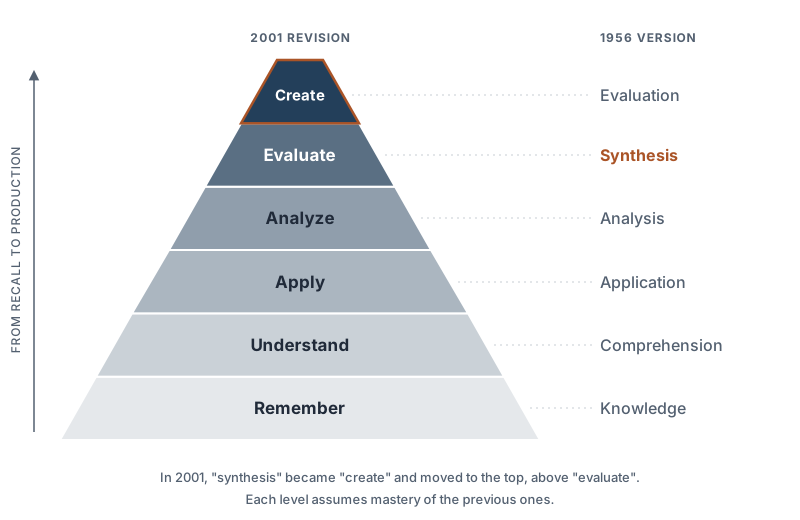
The original taxonomy is hierarchical and cumulative: each level assumes mastery of the previous ones.
- Knowledge
- Comprehension
- Application
- Analysis
- Synthesis
- Evaluation
In 2001, David Krathwohl, one of the original authors, and Lorin Anderson published a revision that changed two important things. First, it separated two dimensions the 1956 version had mixed together: the form of knowledge (factual, conceptual, procedural, metacognitive) and the cognitive process involved (remember, understand, apply, analyze, evaluate, create). Second, it replaced "synthesis" with "create" and moved it to the top, above "evaluate". An objective now reads as a cell in a two-dimensional table: "understand a concept", "apply a procedure", "evaluate a theory".
What is a learning objective?
A learning objective expresses how we expect a person to change through the learning process: what they will think, feel or do differently. It is almost always written on the same pattern:
The learner should be able to VERB + SUBJECT OF LEARNING.
For example: "recall the law of supply and demand", "explain the principle of natural selection in your own words", "construct an original example of an argument by analogy". The verb names the cognitive process, the object names the knowledge being targeted. This combination is what makes the objective verifiable.
Objectives can come from three sources: teachers, learners themselves (what they already know, their interests, the situations they encounter) and subject-matter experts. Ralph Tyler summed up the work of designing a curriculum in four questions that have not aged:
- Which learning objectives should be reached?
- Which learning experiences make it possible to reach them?
- How should these experiences be organized so that they form a continuous whole rather than a series of isolated topics?
- How can the effectiveness of each experience be evaluated?
Level 1: knowing, remembering, recognizing
This is the most common category of objectives, and often the least loved. Yet it covers very different kinds of knowledge:
- Specific facts: the terminology of a field (the jargon experts use among themselves) and specific facts (dates, people, places, sources).
- Ways of dealing with specifics: conventions (usage, style, rules of presentation), trends and sequences, classifications, criteria of judgment and the methodology of a field.
- Abstractions: principles that summarize observations, then theories that link those principles into a systematic view of a complex phenomenon.
Three remarks make this level more interesting than it looks. Knowledge that is organized and connected to other knowledge is better retained than isolated knowledge. Remembering depends on the cues available at the moment of recall, which is why it pays to vary the way a question is asked. And knowledge is a prerequisite for everything else: without facts and concepts in memory, there is nothing to analyze or evaluate.
How do you test it? By checking that the person can state or recognize true propositions in answer to questions. The form of the question and the expected level of precision should not stray too far from the form in which the knowledge was learned, otherwise you are testing something other than memory.
Level 2: understanding
To understand is to be confronted with a communication (a text, a diagram, a formula) and to be able to do something with it. The taxonomy distinguishes three comprehension behaviors, in order of increasing difficulty.
Translation means transforming a communication from one form into another: restating a concept in your own words, summarizing a text, illustrating an abstract idea with an example, turning a chart into a sentence or a sentence into a diagram. It is the hinge between memory and the higher levels.
Interpretation means grasping a communication as a configuration of ideas: understanding the relationships between its parts, telling the essential from the incidental, relating it to your own experience. Being able to distinguish warranted, unwarranted and contradictory conclusions drawn from a document is a matter of interpretation.
Extrapolation means extending a communication beyond the limits set by its author: estimating consequences, predicting the continuation of a trend, distinguishing a value judgment from a prediction.
How do you test it? For translation, present the definition of a concept in a form different from the one that was learned, or ask the learner to recognize examples of the concept among counter-examples. For interpretation, give a document and ask for its consequences, its summary or its outline. For extrapolation, ask for a prediction. In every case the context must be new to the learner, otherwise you are back to a memory test.
Levels 3 to 6: apply, analyze, evaluate, create
The higher levels are the ones we mention most and assess worst, because they require open-ended situations.
- Apply: execute a known procedure in a new situation, or implement a general method on an unfamiliar problem.
- Analyze: break a communication down into its elements, make the relationships between those elements explicit, then recognize the organizing principles that structure it (the author's point of view, technique, bias).
- Evaluate: make a reasoned judgment, either from internal evidence (consistency, logical accuracy) or from external criteria (comparison with standards or with other works).
- Create: produce an original communication, a plan or an ordered set of operations, or synthesize a set of abstract relations into a theory or a model.
The revised taxonomy insists on a useful distinction: intellectual abilities let you use remembered technical knowledge on a new problem; intellectual skills let you use a general method in a new situation. The former are learned through repetition, the latter through variety.
Other classifications
Bloom is not alone. Gagné proposes a five-step learning hierarchy (verbal association, discrimination, concept learning, rule learning, problem solving). Ausubel and Robinson distinguish representational, concept and propositional learning, followed by application, problem solving and creativity. Gerlach and Sullivan prefer six observable behaviors: name, order, identify, describe, demonstrate, construct. These frameworks overlap widely and confirm an intuition: there is a natural progression from recall to production.
What this changes for a tutor, human or AI
The practical value of the taxonomy is that each level maps to a family of activities. A multiple-choice question or a cloze test checks recall. A restatement, a summary or picking the right example checks understanding. A case study checks application, a critique of an example checks analysis and evaluation, building an original example checks creation.
| Level (2001) | Typical verbs | Exercise that checks it |
|---|---|---|
| Remember | recall, recognize, name | multiple-choice question, cloze test |
| Understand | restate, summarize, illustrate, predict | restatement, summary, picking the right example |
| Apply | execute, use, implement | case study, unfamiliar problem |
| Analyze | break down, relate, distinguish | critique of an example, spotting a bias |
| Evaluate | judge, compare, justify | reasoned critique against explicit criteria |
| Create | produce, design, construct | building an original example, a plan, a model |
For the Remember level, well-written flashcards reviewed on a spaced schedule are the most efficient format; we compared the best AI flashcard makers on exactly that criterion.
This is exactly the logic we follow in Fenelon: a learning goal is broken down into finer objectives, each placed at a level of the taxonomy, and that level decides which type of exercise is offered. A learner who fails an understanding objective does not need a longer exercise; they need an exercise at a different level, often one step down, before climbing back up.
Bloom's taxonomy is not a theory of learning. It is a language. But a language shared by the person who designs a path, the person who assesses it and the person who follows it is often worth more than a theory.