Critical Questions and Argumentation Schemes: Learning to Evaluate an Argument
Toulmin's model, Walton's schemes, defeasible arguments and the burden of proof: a toolbox for evaluating an argument, and what LLMs can and cannot do with it.
This article is also available in French.
We accept or reject arguments all day long: in an article, a meeting, an advertisement, a conversation. Most of the time we do it by intuition. Argumentation theory offers something sturdier: models of the structure of arguments, a catalogue of their common forms and, for each form, the list of questions that test its strength. These critical questions are one of the most useful tools of critical thinking. They have also recently become a testing ground for large language models.
Toulmin's model: the anatomy of an argument
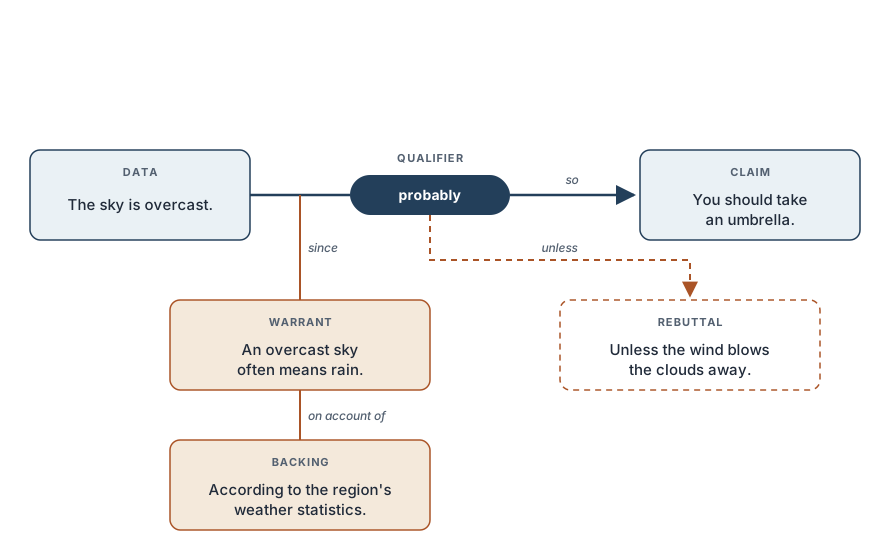
Stephen Toulmin proposed in 1958 a description of argument that remains the most widely used. A complete argument has six elements:
- The claim: the assertion we want to have accepted.
- The data: the evidence used to support it.
- The warrant: the statement that explains why the data support the claim.
- The backing: the underlying assumptions that reinforce the warrant.
- The rebuttals: the conditions under which the claim would not hold.
- The qualifier: the degree of certainty of the claim ("probably", "unless").
Example. "You should take an umbrella" (claim), "the sky is overcast" (data), "an overcast sky often means rain" (warrant), "according to the region's weather statistics" (backing), "unless the wind blows the clouds away" (rebuttal), "probably" (qualifier). Breaking an argument down this way reveals what is left unsaid: most often, the warrant.
Walton's argumentation schemes
Douglas Walton catalogued argumentation schemes: forms of argument that represent common structures in everyday, scientific or legal discourse. They include the deductive and inductive forms of classical logic, but also a third family, often the most interesting: defeasible arguments. A defeasible argument is one whose conclusion can be accepted on the available evidence, but revoked if new evidence appears. Reasoning based on a generalization subject to exceptions is the typical case.
Schemes can be grouped into families. Each has its own critical questions; here is one per family, by way of example.
| Family | What it does | Typical critical question |
|---|---|---|
| Knowledge and authority | Passing on an opinion deemed reliable: position to know, expertise, testimony, popular opinion. | Is the source really in a position to know, and in this specific field? |
| Causality and diagnosis | Linking phenomena by cause, effect or sign. | Does another explanation account for the same facts? |
| Classification and analogy | Placing a case in a category to apply a property to it, or claiming that two similar cases call for the same conclusion. | Are the two cases alike in the respects that matter for the conclusion? |
| Deliberation | Recommending an action to reach a goal: instrumental reasoning, arguments from values, from consequences, from sunk costs. | Is there another way to reach the goal, or negative consequences left unmentioned? |
| Personal | Attacking the interlocutor rather than the argument. | Does the trait held against the person bear on their reliability about this subject? |
| Slippery slope | Warning of a drift presented as inevitable. | Is each step of the drift really inevitable, and what prevents stopping along the way? |
Two epistemic families deserve detail. The schemes that apply rules to cases: established rule, precedent, analogy, verbal classification. And the schemes by discovery: best explanation (a hypothesis is plausible because it best explains the facts), sign, the move from correlation to cause, and the argument from ignorance (a proposition is false because no evidence was found after an appropriate search). These schemes are close cousins of cognitive biases: a bias is often a scheme applied outside its conditions of validity.
The argument from sign
"I see bear tracks on the trail. So a bear passed here recently." This reasoning is merely plausible. It is legitimate only under conditions of doubt and lack of information, and it must yield to a better explanation (tracks molded by a prankster, for instance).
The argument from authority, or expert opinion
This is the most common scheme and the most misused. Its structure: source E is an expert in domain S containing proposition A; E asserts that A is true; therefore A is true. Walton attaches six critical questions to it:
- Expertise: how credible is E as an expert?
- Field: is E an expert in the field that A belongs to?
- Opinion: what did E actually assert that implies A?
- Trustworthiness: is E personally reliable as a source (biased, honest, conscientious)?
- Consistency: is A consistent with what other experts assert?
- Evidence: is E's assertion based on evidence?
A more rigorous version of the scheme adds an explicit conditional premise ("if E is an expert and asserts A, then A should be taken as probably true"), which turns it into a plain modus ponens and shifts the whole debate to the acceptability of that conditional.
How to attack an argument
There are two broad ways to attack an argument: criticize it or refute it. You can put forward a counter-argument, whose conclusion is the negation of the original conclusion. You can attack a premise, by questioning it or showing it is false. For a defeasible argument there is a third route: attacking the inference rule, the warrant or the generalization it rests on, for example by citing an exception.
The final evaluation of an argument comes down to three criteria: the acceptability of the premises, their relevance to the conclusion, and their sufficiency, that is, whether they constitute a strong enough reason to conclude.
Critical questions and the burden of proof
Critical questions can be understood in three ways: as a form of attack on a defeasible argument, as deeper implicit assumptions that have not been established, or as starting points for finding a refutation.
They are not all equal with respect to the burden of proof. In the expert scheme, asking questions 1, 2 or 3 sends the burden back to the person who put forward the argument: they must establish the expertise, the field, the exact assertion. Asking questions 4 or 5, on the contrary, places the burden on the questioner: accusing an expert of bias requires grounds. This asymmetry explains why some objections are admissible without evidence and others are not.
One question remains open: when to stop? Once all the critical questions have been asked, should we accept the argument, or open new sub-questions? At what point is an argument strong enough? The theory provides no stopping rule. It is a judgment, and it is precisely that judgment that has to be learned.
Where do LLMs fit in?
Since 2024 a research task has formed around critical questions generation: using a language model to ask the questions that expose the weak points of a person's argumentative discourse. The first work on the subject started from very simple prompts ("list the critical questions that should be asked before accepting the arguments in the following paragraph") and had the generated questions annotated by humans into three categories:
- useful: the answer to the question can change one of the arguments in the text;
- not useful: the question is valid, but its answer will probably change nothing;
- invalid: the question cannot challenge any argument, because its reasoning is wrong, it is not related to the text, it introduces concepts absent from the text, it is so general that it would apply to any text, or it is a mere reading-comprehension question.
A reference dataset followed in 2025, built from debate corpora annotated with their argumentation schemes, with several thousand evaluated questions. The task proved difficult: models readily produce plausible but generic questions, of the "what are the sources for this claim?" kind, which apply to everything and attack nothing. The winning system of the competition organized that year worked in two steps, generating many questions and then selecting the most specific ones, which says clearly where the difficulty lies: not in production, but in selection.
This difficulty is instructive for the learner. A good critical question is specific to the text, tied to a precise argument, and its answer could change the conclusion. These are exactly the criteria that distinguish an objection from a mere display of skepticism.
An exercise to practice
Take an editorial, a speech or an advertisement. Identify the main claim and its data. Look for the implicit warrant. Determine which scheme the argument belongs to: authority, sign, analogy, consequences? Then ask the critical questions specific to that scheme, noting for each one who carries the burden of proof. Finally, decide: accept, reject, or suspend judgment.
This is the kind of exercise Fenelon generates from the texts a learner studies: spotting a scheme, formulating a useful critical question, telling a contestable premise from a fragile inference rule. Language models are used there to produce varied cases and to assess answers against explicit criteria, not to judge in the learner's place.
Conclusion
Argumentation schemes give a name to the forms of reasoning we use without thinking, and critical questions give, for each of them, the list of points where they can give way. Knowing how to recognize them does not make you skeptical of everything: on the contrary, it lets you accept an argument knowing why, and reject it knowing where.