The Memory Paradox: Why Learn by Heart in the Age of AI
Cognitive offloading, mental schemas, engrams and epistemic friction: what cognitive science says about our reliance on digital memory aids, and how to learn anyway.
This article is also available in French.
"Why learn it by heart when I can look it up in three seconds?" Students have been asking this since search engines arrived, and conversational assistants have given it new force. A paper published in 2025 under the title "The Memory Paradox" turns the question around: is our growing reliance on digital memory aids and digital distractions gradually eroding the very intellectual capacities we are trying to develop? Here is what cognitive science lets us answer.
Knowledge and skills are two sides of the same coin
There is no skill without knowledge. The pedagogical debate of the last thirty years has often been reduced to a slogan: "a guide on the side, not a sage on the stage". The teacher accompanies, the student discovers. The formula is appealing, but it rests on a confusion between two kinds of knowledge.
Primary knowledge, such as language or face recognition, is acquired on its own, by simple immersion. Secondary knowledge, such as reading, mathematics or science, is not acquired naturally: it requires explicit teaching, repetition and time. Discovery-based pedagogies work well for the former and much less well for the latter. And it is the latter we are trying to pass on.
Cognitive offloading
When I use a tool to reach the result of a mental operation faster, I offload the mental effort needed to solve it. Psychologists call this cognitive offloading. The phenomenon is not new: writing, notebooks and calculators are all forms of offloading. What has changed is its scope. An assistant that can write, summarize, compute and remember on our behalf lets us offload almost everything.
The problem is not offloading as such, it is excessive offloading at the moment of learning. Internalizing knowledge takes effort: that effort is what builds the mental representation. Skipping it leaves a weak mental schema that cannot later support critical thinking or problem solving. We believe we have learned because we obtained the answer.
A troubling clue: after decades of increase, average IQ has been declining in several Western countries since the 1990s. The causes are debated, and a correlation is not an explanation. But the coincidence with the spread of digital memory aids at least deserves the question.
Two memories, not one
To understand what is lost, we need to distinguish two memory systems.
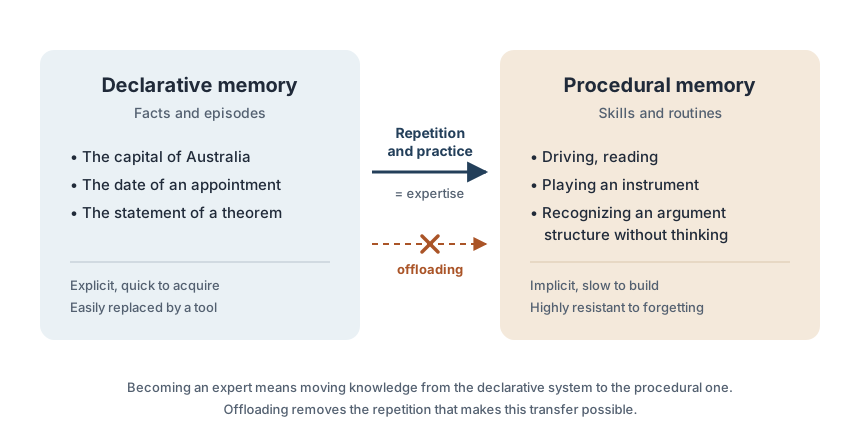
Declarative memory stores facts and episodes: the capital of Australia, the date of an appointment, the statement of a theorem. It is the one digital tools replace most easily.
Procedural memory stores skills and routines that have become second nature: driving, reading, playing an instrument, recognizing an argumentative structure without thinking about it. It is implicit, slow to build and highly resistant to forgetting.
Developing real expertise often consists in moving knowledge from the declarative system to the procedural one. You practice until the skill is embedded in the unconscious networks that make intuition and fluid thinking possible. An expert does not "search": they see. And that transfer requires precisely the repetition that offloading spares us.
Mental schemas and engrams
Internalized networks form structures called schemas. A schema organizes knowledge and enables complex thinking: when a chess player looks at a position, they do not see thirty-two pieces but a handful of familiar configurations. Schemas develop gradually through practice with concepts. Metaphors enrich them by linking a new concept to an experience that is already known.
At the biological level, the physical trace of a memory is called an engram: the state of neural connections left by an experience. An engram is formed through repetition and through the association of ideas, concepts and experiences. No external search builds it for us.
Epistemic friction
There is a second reason why the instant answer teaches nothing. The more a new piece of knowledge contradicts my beliefs, the more slowly I assimilate it. When a person receives information that seems ambiguous or inconsistent with their current beliefs, we can say they are in epistemic friction: a resistance to the new knowledge.
This friction is not a flaw. It is a setting. Too little friction would make us believe anything; too much would prevent us from ever revising our ideas. It depends on the gap between the incoming information and our beliefs: a head-on contradiction produces strong friction, a marginal one produces weak friction. Recent work on dialogue even tries to quantify it in order to calibrate how fast ideas get revised.
Learning means crossing that friction. A tool that gives the answer before we have had time to form our own hypothesis removes it: nothing rubs, nothing sticks.
The strategies that build memory
Cognitive science identified long ago the practices that strengthen engrams. They all have one thing in common: they demand effort at the right moment.
- Retrieval practice: try to remember before checking. Testing yourself beats rereading.
- Spacing: spread revisions over time rather than cramming them. Flashcard apps with a spaced repetition scheduler do this for you — see our comparison of the best AI flashcard makers.
- Interleaving: alternate between different but related topics. This technique forces you to repeatedly discriminate between several engrams, which strengthens each of them.
- Generation: produce an answer, even a wrong one, before receiving the right one.
- Elaboration: explain in your own words, connect to an example, find a metaphor.
Offloading then has its place, but after the effort, not instead of it. Checking an answer you first attempted is one use of the tool; having it handed to you from the start is another.
What this implies for an AI tutor
An assistant that answers everything is the worst possible tutor, not because it is wrong, but because it succeeds too fast. In Fenelon we made the opposite choice: the exercise comes before the explanation, the question before the answer, and reviews are spaced out over time according to successes and failures. AI is used to choose the content and the right moment, not to think in the learner's place.
Conclusion
The memory paradox fits in one sentence: the tools that make knowledge most accessible are the ones that make its acquisition least likely. The solution is not to give up the tools, but to reclaim what they cannot do for us: the effort of retrieval, spaced repetition, the friction of an idea that resists. That effort, and it alone, leaves a trace.